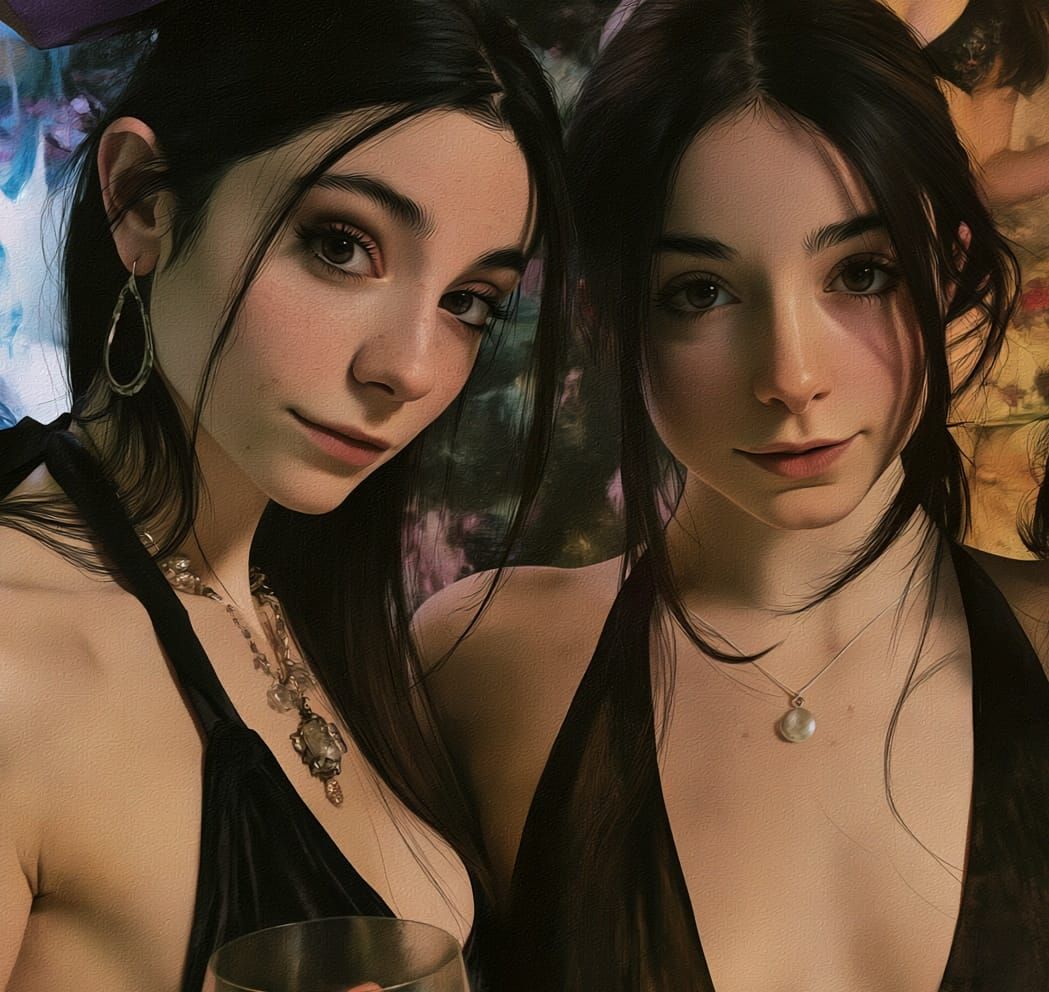
The gallery was a suffocating crush of bodies, expensive cologne, and the hollow laughter of the city’s upper crust. He had come because his business partner insisted—a necessary social tax, a night of shaking hands and smiling at mediocre abstract canvases. He had been standing near the bar, nursing a glass of scotch he had no intention of finishing, when the noise of the room seemed to curdle, collapse, and fall away.
They were standing three feet from him. Two of them. Unmistakably, devastatingly them.
They did not enter the space so much as they occupied it. They were dressed in matching deep, obsidian velvet—halter tops that plunged with a casual, breathtaking audacity, exposing the pale architecture of their collarbones and the heavy beginnings of their chests. Their hair was a shared, inky cascade, parted in the middle and falling in sleek, dark curtains. They looked like reflections of a single, fractured entity, separated by only a breath of space.
The one on the left wore a heavy, ornate pendant—a cluster of dark, smoky stones and tarnished silver resting against the hollow of her throat. A large, teardrop hoop swung from her ear. She held a half-empty glass of white wine, her fingers wrapped loosely around the stem.
The one on the right wore only a single, large pearl on a thin, silver chain, a drop of lunar luminescence resting against her sternum. Her face was softer, more placid.
They were young. Their skin held that unblemished, luminous sheen of early adulthood. The frames of their bodies, visible beneath the plunge of the velvet, were slender—the high, sharp blades of their collarbones, the narrow, boyish architecture of their shoulders, the delicate, unbuilt lines of their hips. They were not yet fully womanly; they were in the budding, that treacherous, fleeting season where the softness has not yet filled out the angles. He could see, beneath the heavy velvet, the fine, frail scaffolding of youth.
And yet, the flowers were bursting. The heavy, perfect weight of their breasts strained against the plunging necklines, a voluptuous promise that belied the slender, girlish frames. It was a paradox of form—an innocence of bone and a readiness of flesh—that struck him with the force of a physical blow.
He ate them with his eyes. He allowed himself the secret, silent gluttony. He traced the sharp line of the left one’s jaw, the soft, vulnerable hollow at the base of her throat where the heavy pendant rested. He followed the curve of the right one’s shoulder, the pale, unblemished skin leading down to the solitary pearl.
The crowd shifted. Someone behind him—a large, clumsy man gesturing broadly at a canvas—jostled his shoulder. He was shoved forward, a single, stumbling step. His shoulder collided, softly, with the left one’s. The touch was brief, a brush of his suit jacket against the bare, velvet-clad curve of her arm. He felt the shock of her warmth through the fabric. He felt the yielding, soft resistance of her flesh.
She did not stumble. She did not pull away. She simply turned her head, slowly, and looked at him. Her dark eyes held his, the corners of her lips curving just slightly.
“Well,” she murmured. “We were wondering when you would make contact.”
He opened his mouth. He heard himself speak before his brain could intercept the words. “I didn’t mean to. I was pushed.”
It was a dumb thing to say. It was the banal, apologetic reflex of a man who had never learned to accept a gift without first offering an excuse.
But instead of dismissing him, the right one tilted her head. Her dark hair shifted, revealing the pale shell of her ear. “You didn’t mean to,” she repeated, her voice a soft, airy echo. She did not mock him; she simply observed the fact, as if it were an interesting variable in a long, unfolding equation.
He saw it, then. In a sudden, non-linear flash, the image broke through the membrane of the present. A room. Not the gallery. Darker, smaller, the walls draped in heavy, gold-threaded curtains. A low bed with white sheets, rumpled. The left one, kneeling, her dark hair spilling over her shoulders. The right one, positioned behind her, her thighs bracketing her friend’s hips. He saw—with the brutal, clinical clarity of a fever dream—the right one's hand reaching forward, her fingers finding the base of what was thrusting into the left one, her palm squeezing the slick, wet root of it, guiding it, protecting it, drawing out the rhythm into an endless, aching suspension. He felt the wet heat of it, the shared, clandestine breath. He felt the three of them dissolving into a single, sweating, breathing organism.
The flash receded. He was back in the gallery, the ambient noise rushing in like cold water. The women were still standing before him, three feet away, waiting.
“The question,” the left one murmured, her dark eyes locked on his, “is not whether we like you. It is whether you are brave enough to let us prove it.”
She lifted her wine glass to her lips. She took a slow, deliberate sip, her eyes never leaving his. The glass came down, and she smiled—a slow, devastating curve that revealed the faint, wet gleam of her teeth.
“We will be outside. In thirty minutes. By the iron gate.”
They turned to leave. The left one went first, pivoting on a heel, her dark hair swinging. The right one hesitated for a fraction of a second—a tiny, almost imperceptible lag—and when she moved to follow, her shoulder caught the edge of a tall, decorative easel. It shuddered, and she had to put her hand out, just for a moment, to steady the cheap wooden frame.
It was nothing. A micro-second of clumsy, human accident. But he saw it. In the dim, amber light, he saw the brief, startled flicker in her dark eyes—a flash of the girl beneath the veil, the girl who was not entirely sure of her own theatrical footing.
She recovered immediately. She did not look back. She straightened her spine, smoothed the obsidian velvet over her hip, and followed her companion into the thicket of the crowd.
But the spell had cracked, just enough. The cold, omniscient fantasy had shattered, and in its place stood two very young, very real women, trying very hard to project a certainty they did not entirely feel.
He stood alone by the bar, his scotch forgotten, his heart hammering a strange, arrhythmic beat against his ribs.
He thought of the flash—the dark room, the gold curtains, the delicate, slender hips, and the wet, steady rhythm of a hand squeezing the base of a shared, buried heat. It was gauzy, dreamy, a half-remembered memory from a future that had not yet occurred.
But now it was anchored by reality. By the sight of a girl bumping into an easel and catching her breath.
He looked at his watch. Thirty minutes.
He left his scotch on the bar and walked toward the exit. The banal conversation about the weather, or the wine, or the tedious paintings, would have to come later. He was going to the iron gate. He was going to see if the dream had a spine, and if the girl who stumbled was brave enough to let him see her fall.