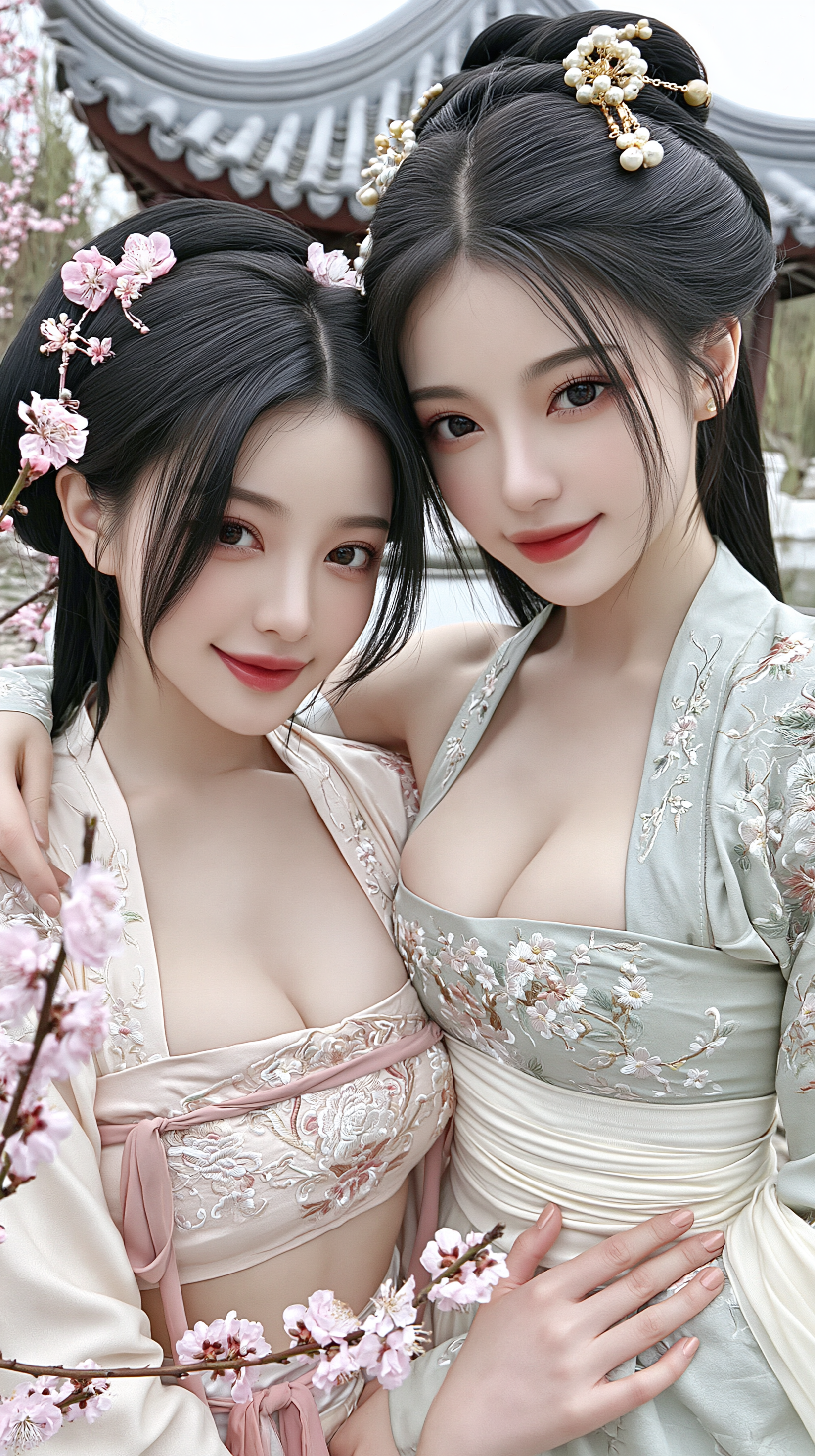
The courtyard of the plum blossoms had been a refuge for him, a place where the rigid, masculine architecture of his life—the courtly debates, the martial drills, the endless, suffocating formalities—could dissolve into the quiet, shifting rhythms of the natural world. He had come here to walk, to clear his head, to escape the oppressive weight of his own lineage. He had not expected to find a world he was forbidden to enter.
They were standing beneath the boughs, two young women framed by a lattice of pink and white blossoms against the grey, curling slate of the pavilion roof. The air was thick with the scent of damp petals and wet earth, a perfume of early spring. They stood close, nearly touching, their dark hair adorned with delicate ornaments—pearls and pink cherrywood, swaying with the soft, almost imperceptible breeze.
When they turned to face him, the light changed.
Their robes were a devastating clash of silk and softness, draped in the ancient way, but cut with a modern, treacherous daring. The woman on the left wore a sheath of pale, blushing peach, the fabric gathered tightly beneath her breasts, spilling in a cascade of intricate white and silver embroidery down her torso. But the silk did not climb to her throat; it plunged, deliberately, aggressively, opening a vast, pale expanse of her chest to the cool air. The soft, heavy curve of her breasts rose above the embroidered edge, the skin luminous and unblemished, the shadow of her cleavage a deep, perilous valley that seemed to swallow the morning light.
Her companion, taller, stood in a robe of sage green, the fabric adorned with pale, trailing blossoms that seemed to grow from the silk itself. Her neckline was equally daring, square and low, revealing the fine architecture of her collarbones and the taut, smooth swell of her chest. A single, loose strand of her dark hair had escaped the elaborate pearl-and-gold pins, falling across her shoulder, grazing the exposed skin of her chest. Her hand rested casually on the other woman's waist, her fingers pale, the nails unpolished, resting with a proprietary, intimate ease.
They looked at him. Not with surprise, not with modesty. They looked at him with a placid, knowing amusement, their lips painted the same soft, roseate red, curved into identical, infuriating smiles.
He stopped walking. The gravel path seemed to turn to liquid beneath his feet.
His mind, traitor to his composed exterior, began to build an invisible architecture around them. He imagined the world they shared, the one their gestures could not hide. He saw them in a private chamber, the heavy silk robes shed and pooled on the lacquered floor, the pearl ornaments discarded on a low table. He saw the way the woman in green would gently brush the stray hair from the woman in peach’s face, the way their eyes would hold the same gentle, possessive weight they held now. He imagined the low, murmured language of their private world—the soft nicknames, the shared sighs, the secrets whispered into the hollow of each other's necks as the plum blossoms drifted past the latticed window.
There was a terrible, agonizing beauty in witnessing them. It was the beauty of a glassblower watching a flawless, iridescent sphere cool in the kiln—knowing that one wrong breath, one sudden tremor, and the entire, fragile miracle would shatter.
And then the anguish struck him, sudden and violent, like a blade slid between his ribs.
He looked at them, and he realized with a hollow, gutting certainty that he had nothing to do with this. He was not a part of their private world. He was a trespasser, a stray dog who had wandered into a temple. He was an interloper in a story that had been written long before he had arrived, a narrative that did not require his presence, his desire, or his blood.
The woman in peach shifted her weight. She tilted her head, and the plum-blossom pins in her hair trembled. She was looking at him—a stranger in an expensive coat, frozen mid-stride on the gravel path—and she was utterly, devastatingly unimpressed. She was not flattered by his presence. She was not curious. She was simply observing a butterfly that had landed on a branch she happened to be passing.
He felt a hot, acidic surge rise in his throat. It was not jealousy. It was a profound, existential vertigo. He had spent his entire life believing he was the protagonist of his own world, the architect of his own fate. But standing before these two women, wrapped in silk and blossoms, radiating a self-contained, perfect unity, he saw himself for what he was: an appendage. An extra. A man who would walk away from this courtyard in ten minutes, return to his debates and his drills, and they would remain here, laughing softly, touching each other’s wrists, utterly immune to his existence.
What was the point of his lineage if it could not buy him a place in the silent, intimate geometry of their shared smile?
The woman in green raised her hand—the one that had been resting on her companion’s waist—and brought it up, slowly, to her own collarbone. She traced the edge of her low-cut robe with a single, leisurely finger, her unpolished nail grazing the pale, vulnerable skin. It was not a gesture directed at him. It was a private gesture, a moment of unconscious, self-sensual awareness that she had simply happened to perform in his presence. She was not inviting him; she was ignoringhim so completely that her body had become its own territory.
He felt the physical weight of his own exclusion settle in his chest like a heavy stone. He could not force his way into their world. He could not seduce, demand, or purchase entry. It was not a world that recognized currency or male strength. It was a world built on the soft, silent scaffolding of touch, of shared glances, of a language he had never learned to speak.
He took a step backward. The gravel crunched beneath his heel, a sound that seemed obscenely loud in the quiet, petal-filled air.
The woman in peach turned her head, just slightly, her rose-painted lips curving a fraction deeper. She looked at him, and she saw him retreating. She did not call out. She did not wave. She simply let her gaze linger on his face for one long, agonizing moment, as if she were memorizing the shape of a man who had just decided to leave.
And then, with a tenderness that sliced him deeper than any blade, she leaned in and pressed her lips, a soft, fleeting kiss, to the temple of the woman in green. It was a gesture of such profound, uncomplicated intimacy that he felt his lungs seize.
He turned. He walked away, his steps rapid, uneven, his hands clenched into fists at his sides. The scent of the plum blossoms followed him, cloying and cruel.
He had seen a perfect world, sealed in silk and pearls, and he had discovered, with a clarity that would haunt his sleep for months, that he was an uninvited ghost passing through a garden that would bloom just as beautifully without him. The terrible truth was not that he could not have them. The terrible truth was that, in their silent, happy world, he had never been necessary in the first place.