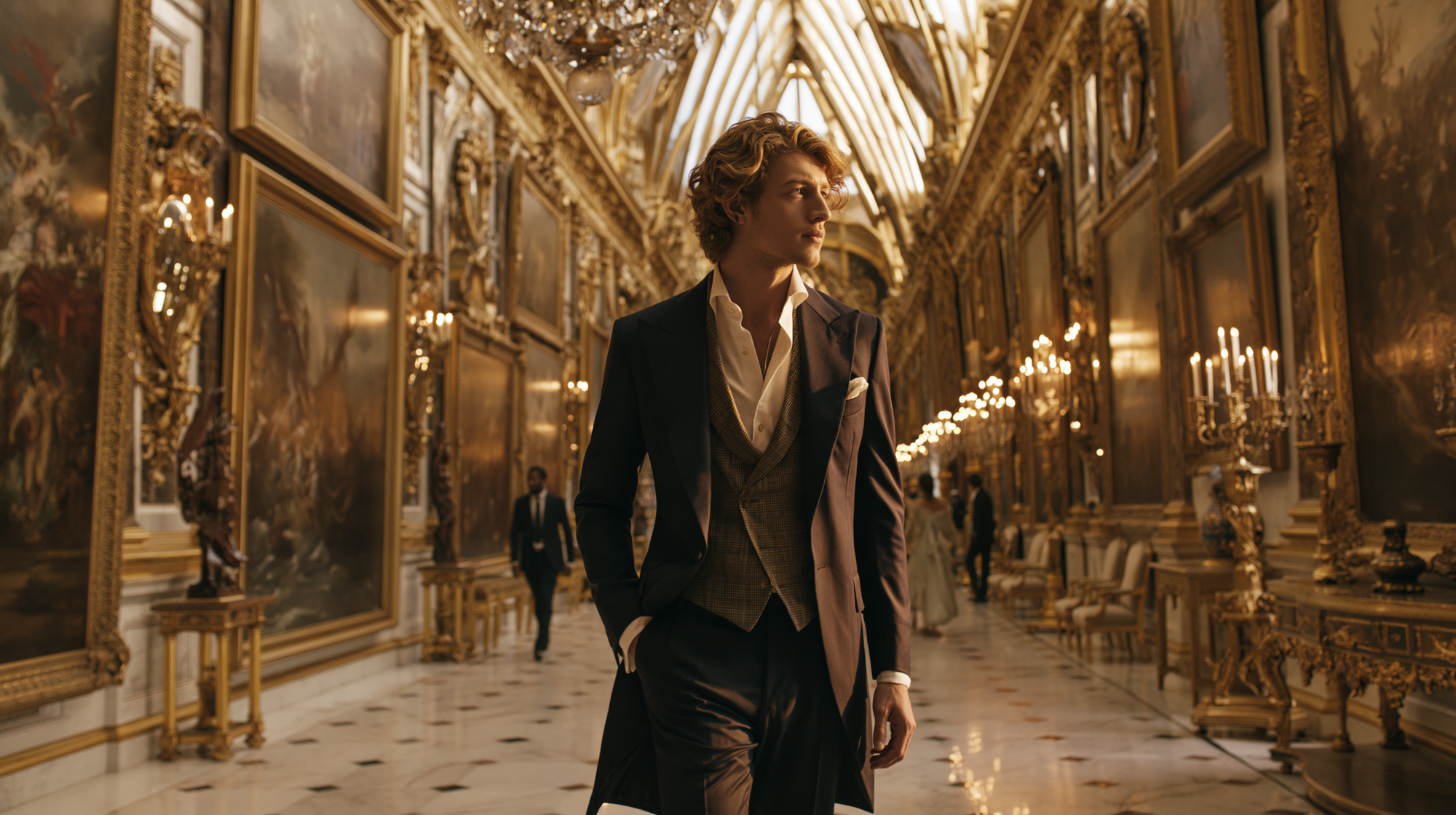
The light in the long gallery was the color of old honey, thick and viscous, hanging in the air like a held breath. It bled from a dozen crystal chandeliers, casting a warm, amber patina over the gilded moldings, the towering oil paintings, the polished marble floor that stretched into a vanishing point of dizzying, opulent depth.
He stood in the middle of it, half-turned, his hands pushed deep into the pockets of his dark trousers. He was not looking at the art. He was looking past it, toward the far end of the hall, where the figures of other guests blurred into soft, indistinct shapes.
He was younger than the room. That was the first thing one noticed. The gallery was a monument to history, to centuries of heavy, aristocratic silence, to fortunes built on the backs of unseen laborers. He was a creature of the present—restless, unmoored, his energy a quiet, crackling hum that seemed out of place among the heavy, gilded frames.
He wore a tailored navy tailcoat, the shoulders sharp and precise, the fabric dark and matte against the gleaming gold of the walls. Beneath it, a waistcoat of muted, brown plaid, fitted close to his ribs. His white shirt was unbuttoned at the collar, a deliberate, casual breach of the room's rigid code, revealing the pale, smooth column of his throat. He held himself with the studied nonchalance of a man who had grown up in rooms exactly like this one, and who had long since grown bored of their silent, suffocating grandeur.
He was beautiful, in the way that a young man who has not yet been worn down by life is beautiful. His hair was a thick, tousled wave of auburn and gold, catching the chandelier light and holding it like spun copper. His jaw was sharp, his lips full and slightly parted, his eyes—a pale, liquid green—scanning the distance with a flicker of restless boredom.
But he was not just a bored young heir. There was a tension in him, a coiled, suppressed energy that belied his relaxed posture. His hand, pushed deep into his pocket, was clenched into a fist. The muscle in his jaw ticked, a microscopic, rhythmic pulse. He was waiting.
He was waiting for someone to walk through the heavy, gilded door at the far end of the hall.
He had been waiting for three years.
Her name was Elena. She was the daughter of a minor Italian count, a woman who had been promised to a man twice her age, a man whose name was etched into the deed of this very gallery. He had met her at a debutante ball when he was nineteen, and she had been seventeen. She had been standing by a fountain, her pale, bare shoulders catching the moonlight, her dark hair pinned with a simple, silver clip. She had looked at him, her eyes the color of deep, shadowed river water, and she had smiled—a small, quiet, devastating smile that had burrowed into his chest like a splinter.
He had not seen her in two years. She had been married off to the ancient count, whisked away to a villa in Tuscany, a pawn in the endless, tedious chess game of European aristocracy. But word had reached him, through a servant he had bribed, that she would be attending the gallery opening tonight.
He had come to the gallery not for the art, but for a glimpse of her.
He shifted his weight. The polished marble floor groaned faintly beneath his heel. He caught the eye of a passing waiter, a young man in a white, starched jacket, and shook his head, refusing the tray of champagne.
He turned, his body rotating, his gaze sweeping the length of the hall. The light caught the sharp angle of his jaw, the faint, golden stubble on his cheek, the restless, liquid movement of his pale green eyes. He was a portrait of youthful, restless hunger, a creature of raw, unfulfilled longing trapped in a mausoleum of gilded silence.
And then he saw her.
She was standing by a massive, gilt-framed canvas, a painting of a dark, storm-tossed sea. She was older now, her face having lost the soft, round curve of adolescence, replaced by a sharp, elegant architecture of cheekbone and jaw. She wore a gown of deep, wine-colored velvet, the neckline a low, sweeping curve that exposed the pale, luminous landscape of her collarbones and the soft, heavy swell of her breasts. Her dark hair was swept up, a cascade of heavy, shining waves pinned with a single, pearl-studded clip.
She looked exactly as he had remembered her. And she looked like a stranger.
She was talking to a man—her husband, the ancient count, a grey, shriveled figure in a stiff, black coat. The count was nodding, his thin lips moving in a slow, droning monologue. Elena's face was a mask of placid, polite attention. She smiled at the count, a small, tight, practiced curve.
He watched her from across the hall. The space between them was a long, polished expanse of marble, a gilded desert that seemed to stretch for miles. He watched her laugh at something the count said, a sound that did not reach her eyes. He watched her reach up, her fingers brushing a stray strand of hair from her cheek, a gesture so small and unconscious that it made his chest ache.
He had spent three years imagining this moment. He had rehearsed it a thousand times—the words he would say, the way he would approach her, the way she would turn, her eyes widening with recognition, her smile breaking through the mask.
But standing in the honey-gold light of the gallery, watching her smile at the ancient count, he realized that he had no plan. He had only a desperate, aching hope.
She turned. Her gaze drifted across the room, a casual, sweeping survey of the crowd. It landed on him.
She stopped.
He saw the flicker of recognition pass through her eyes—a rapid, micro-second flash of shock, of surprise, of something that looked, for a brief, fleeting instant, like fear.
She did not smile. She did not wave. She simply looked at him, her dark eyes holding his, her expression frozen in a mask of careful, public composure.
The count continued to speak, oblivious to the silent, electric current that had just arced across the marble floor.
He did not move. He did not breathe. He simply stood there, his hands pushed deep into his pockets, his pale green eyes fixed on her, his chest tight with the heavy, suffocating weight of all the words he could not say.
She turned away. She looked back at the count, her head tilting, her lips moving in a practiced, polite response.
But he saw it. Just before she turned, he saw the tiny, almost imperceptible tremor in her lower lip. He saw the way her hand, resting on the count's arm, tightened, her knuckles whitening against the black wool.
She was not indifferent. She was terrified.
He watched her walk away, the ancient count on her arm, the deep, wine-colored velvet of her gown swaying with her hips. She disappeared through the heavy, gilded door, swallowed by the dim, golden light of the adjoining room.
He stood alone in the long gallery. The honey-gold light pooled around him. The heavy, gilded paintings stared down at him, silent, indifferent witnesses.
He did not follow her. He could not. The distance between them was not simply the polished marble floor; it was a continent of consequence, of social contract, of the ancient, unbreakable architecture of their world.
He turned. He began to walk down the long, golden hall, his steps echoing off the marble, his hands still deep in his pockets, his jaw tight.
He had come to the gallery to see her. He had seen her. And the sight of her—the way she had tightened her hand on the count's arm, the way her eyes had flickered with fear—had confirmed everything he had suspected.
She was not happy. She was a prisoner in a gilded cage. And he was the only one who had ever looked at her and seen the bars.
He walked toward the exit. The honey-gold light of the chandeliers faded behind him, replaced by the cold, grey winter light of the street beyond.
He did not know if he would ever see her again. He did not know if there was a world in which he could break her free.
But he knew, with a cold, absolute certainty, that he would not stop waiting. He would stand in the long, golden gallery until the chandeliers burned out, if that was what it took.
He was a young man in a tailcoat, walking out into the cold.
And he was carrying the weight of a woman's unspoken terror in the clenched fist of his pocket.