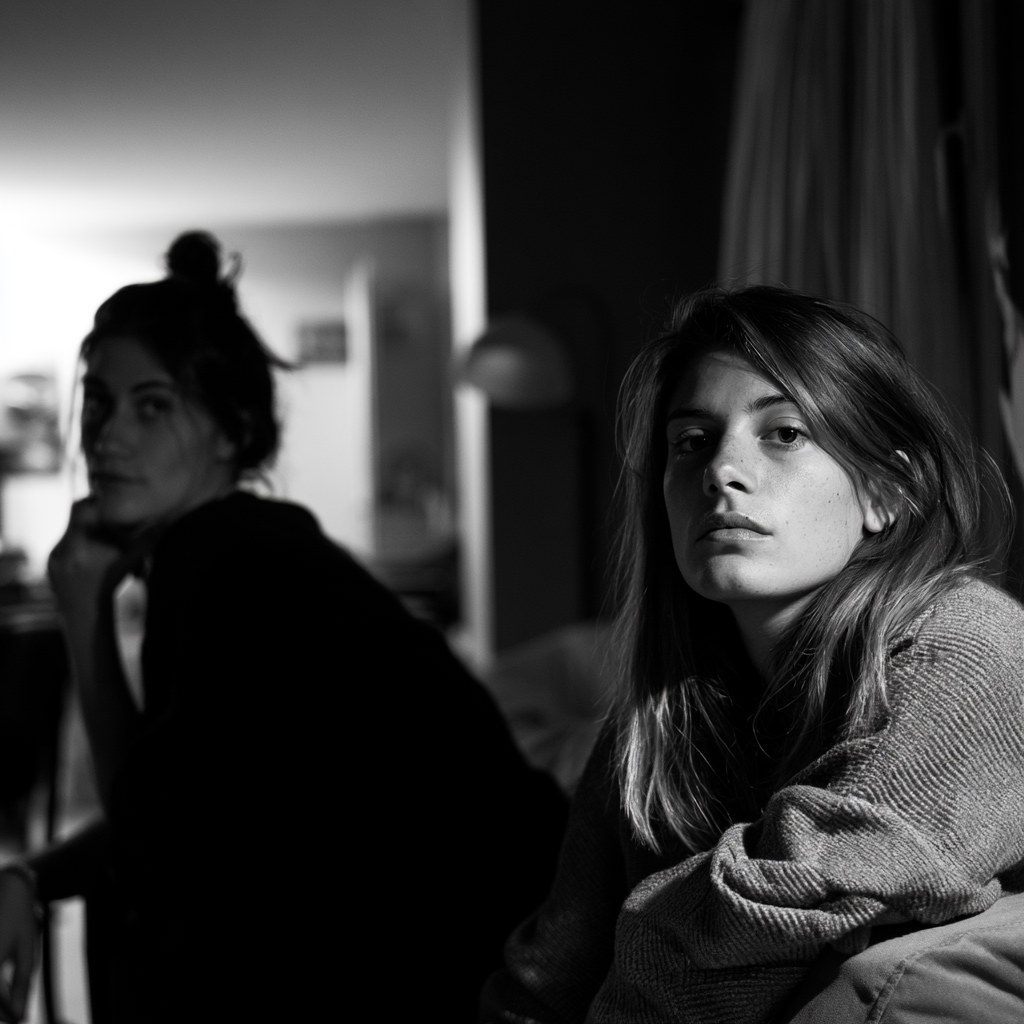
The common room smelled of boiled cabbage, floor wax, and the faint, monastic ghost of incense. The lamp was a ceramic mushroom with a cracked shade, casting a jaundiced glow over the striped sofa and the faded Persian rug that had probably been there since the nuns still wore habits. The cathedral’s clock had just struck eleven, the heavy bronze chime vibrating through the walls like a heartbeat.
Marlene was the large one. She had the thick wrists, the hesitant smile, the way of laughing too loudly at her own jokes to preempt the silence. She was a good soul, earnest, clumsy, and tonight she had been the architect of our improbable gathering—she had invited me back for a final glass of vin blanc because, as she put it, "The old town is dead after ten, and we have a bottle of something that tastes like a priest's regret."
But it was not Marlene I had been watching.
It was Katrin.
She sat on the edge of the armchair, knees drawn up, a thick cable-knit sweater swallowing her frame. She was small, slight, with the kind of face that was easy to miss—dull hair the color of damp straw, a jaw that ran too softly into her neck, eyes that were a washed-out blue, like the sky behind a cloud cover. She was not pretty. She was not elegant. But she was there, completely, with a stillness that made the air around her feel heavier.
We had spent the last hour drinking and talking about the building. The hostel used to be a convent for the Visitation Order, a severe Calvinist offshoot that believed the body was a cage for the soul. Marlene, rosy-cheeked from the wine, had leaned forward and whispered, "They used to make the novices sleep on wooden boards. To remind them that the flesh was a temporary inconvenience."
Katrin had not laughed. She had stared at the far wall, where a plaster crucifix was mounted, and said, "Temporary. That's the cruelest part. It's temporary, but they still had to endure it."
Her voice was low, almost a murmur, and I felt it settle in my chest like a stone in still water. I watched her wrap her thin fingers around her wine glass, the pad of her thumb stroking the rim in a slow, absent circle. She knew I was watching. She did not acknowledge it. She simply let me look, as though my attention was a piece of furniture she had grown used to.
Marlene, oblivious, began a rambling story about the cellar—how a former boarder had claimed to find a hidden door that led to a crypt where the sisters used to keep their hair shirts, relics of penance. Katrin rolled her eyes, a faint, unguarded flash of mockery, and when our eyes met, I felt a jolt of recognition.
You know, her look said. You know what we are doing here.
The conversation veered. Marlene talked about her theology exams. Katrin talked about the sound the cathedral bells made at dawn, how they traveled through the stone and into her bones. I talked about nothing, because I was too busy cataloging the way Katrin’s lower lip caught the light when she took a sip, and the way her neck curved into her shoulder, pale and unguarded.
Then Marlene yawned, a broad, theatrical yawn that signaled the end of her own endurance. She clapped her hands on her knees and stood, the floorboards groaning under her weight. "I am done," she announced. "I need to find my bed before I fall asleep in this chair. You two—don't stay up too late. The porter locks the main door at midnight."
She did not look at us with suspicion. She did not look at us with knowing. She looked at us with the tired, benign oblivion of a person who simply wanted to sleep. She kissed the air near Katrin's cheek, gave me a clumsy pat on the shoulder, and disappeared into the narrow hallway.
The door clicked shut.
Silence rushed in. But it was not a dead silence. It was a living one—thick, humid, electric, like the air before a storm.
Katrin did not move. She stayed curled in her armchair, her glass balanced on her knee, her eyes fixed on the dark window where the cathedral spire rose into the night. The clock ticked. The radiator hissed. Somewhere above, a door closed, and the building settled into its nighttime contortions.
"You think Marlene knows?" she said quietly. Not asking me a question. Testing the air.
"Knows what?" I asked, though I knew.
She turned her head slowly, and the lamplight carved a harsh shadow across her cheek, emphasizing the soft, unremarkable line of her jaw. Her eyes met mine, and they were flat, calm, utterly unafraid. "That I invited her to the bar tonight because I saw you watching me at the café yesterday."
The air left my lungs. I had not expected her to say it. I had expected a dance, a half-step, the usual apprenticeship of flirtation.
"I wanted to see if you would follow," she said, and her lips twitched—not a smile, but the ghost of one. "You did."
I put my glass down. My hands were steady, but my pulse was a sledgehammer against my ribs. "And you want me here?"
She shifted. She uncurled her legs and planted her feet on the rug, her posture shifting from defensive to open. She pulled her hair back from her face, and I saw the small, slight beauty of her ears, the delicate cartilage, the way her neck was too thin, too vulnerable. She let me see it. She did not hide it.
"I want," she said slowly, her voice dropping to a register that was almost lost beneath the hiss of the radiator, "to do something that would make the nuns spin in their graves. I want to do it in this room. I want to hear the wood groan. I want to feel the weight of all those centuries of silence, and I want to break it."
She was not trying to be seductive. She was simply telling the truth. Her eyes were a little glassy from the wine, her cheeks a little flushed, but beneath that was a bright, clear-eyed hunger—not for me, not for any particular body, but for the act itself. For the transgression. For the sheer, delighted mischief of being twenty-three and alive in a place that had forgotten how to be alive.
I felt my own hunger rise to meet hers. It was not a crush. It was not romance. It was a mirror.
"Show me," I said, my voice low.
She did not move. She sat there, perfectly still, and let the silence stretch. Then she uncurled her legs and rose from the armchair in one fluid, unremarkable motion. She was short. Her sweater hung past her hips. She looked like a child in a borrowed coat.
But when she reached down, hooked her thumbs into the hem of her sweater, and pulled it over her head in one smooth movement, it was not the exposed skin that struck me. It was the normalcy of it. The small, pale bra. The slight swell of her ribs. The faint, unremarkable curve of her waist. She was not a masterpiece. She was a woman, utterly ordinary, and her ordinariness was what made the moment holy.
She tossed the sweater onto the armchair and looked at me. Her lips were parted. Her gaze was steady. She waited.
I stood. The floorboards squeaked. I crossed the carpet, my own heartbeat loud in my ears, and when I reached her, I did not grab her. I did not push her. I simply placed my hands on her shoulders, feeling the sharp bone beneath the soft fabric of her camisole. She was so small. So light. So entirely present.
"Here?" I whispered.
She nodded, a single, sharp dip of her chin. "Here. On this floor. On the rug the nuns used to kneel on."
I lowered her. Gently. I followed her down, the old wool of the Persian rug scratching my knees. She lay back, her hair fanning out across the faded floral pattern, her eyes fixed on mine. Her fingers found my jaw, traced the line of it, and she smiled—a real smile, wide, unguarded, beautiful in its pure, unpretentious joy.
"Happy," she whispered. "Make me happy."
The rug smelled of dust, old wool, and the faint, acrid ghost of candle wax. It was rough against my bare knees, the intricate floral pattern worn to a blur in the center, where generations of penitent knees had pressed into the floor. Katrin lay beneath me, her small frame swallowed by the shadow of my body, her hair spilling across the faded blue of a woven iris.
She was not beautiful. But her stillness was a kind of beauty—a rare, unguarded stillness, as though she had finally stopped holding her breath. Her lips were parted, and I could see the chapped, dry edge of her lower lip, the slight discoloration where she had bitten it during the long silences of the evening. Her eyes, that washed-out blue, were fixed on mine with an earnest, terrifying openness.
“Thank you,” she whispered.
It was not a coquette’s whisper. It was not a prelude to seduction. It was a confession. She was twenty-three, adrift in a foreign city, sleeping on a narrow bed in a former convent, surrounded by the ghosts of women who had denied themselves everything. And I was the first person in months—maybe years—who had looked at her not with pity, not with polite disinterest, but with recognition.
I lowered my mouth to hers. Her lips were dry, soft, yielding. She sighed into me, her breath warm and faintly sour with wine, and her small hands found my shoulders, gripping the fabric of my shirt as though I were a life raft.
We undressed each other slowly. Not with the practiced choreography of experience, but with the fumbling, earnest clumsiness of two people who were not quite sure how to do this, but were absolutely certain they wanted to. She tugged at my belt buckle with impatient fingers, her knuckles brushing my stomach, and I helped her, my hands covering hers, guiding her through the motion. She laughed—a low, breathy laugh—when the buckle stuck. I kissed her neck, tasting the salt and the faint floral soap of her skin, and she shuddered, her laughter dissolving into a gasp.
Her bra was plain, white cotton, the kind you buy in a three-pack from a department store. It did not seduce. It did not promise. It simply contained. But when I unclasped it, sliding the straps down her fragile shoulders, the sight of her bare chest hit me with a force I had not expected. Her breasts were small, pale, the nipples a soft, dusty rose. The ribcage beneath was delicate, almost birdlike. She was not a painting. She was a fact—tender, mortal, utterly real.
She reached for me. Her fingers traced the line of my chest, the muscle beneath the skin, and her touch was light, almost reverent. She was not performing. She was learning. I watched her face—the tiny furrow between her brows, the way her tongue darted out to wet her lips—and I understood, with a sudden, piercing clarity, that she had been lonely for a very long time.
I lowered her fully onto the rug. The wool scratched her back, and she arched into it, her spine bowing, her hands reaching up to cradle my face. She pulled me down, and my chest pressed against hers—the soft, warm shock of skin against skin. She gasped, her mouth opening against mine, and I felt her heartbeat, rapid and fragile, like a bird trapped in a cage of bone.
We kissed until the kissing was not enough. We kissed until her legs parted beneath me, her thighs open and unguarded, her hips tilting upward in a wordless, urgent plea. I positioned myself, my hand guiding myself, my breath ragged, and I looked down at her one last time.
Her face was flushed, her eyes half-closed, her lower lip caught between her teeth. She was so ordinary. She was so small. And in that moment, she was the most beautiful thing I had ever seen—not because of her features, but because of her willingness. She had opened herself to me. She had trusted me with her loneliness.
“I want you to remember this,” I said, my voice breaking. “Forever.”
She nodded, her eyes glistening. “I will.”
I entered her.
There is no poetic way to describe the first moment. It is a sudden, wet resistance, a tight, clenching heat, and then a surrender. She gasped, a sharp, surprised cry that caught in her throat, and her fingers dug into my shoulders, her nails leaving tiny, crescent moons in my skin. I paused, letting her adjust, my forehead pressed to hers, our breath mingling.
“Don’t stop,” she whispered. “Please. Don’t stop.”
I moved. Slowly at first—a shallow, tentative rocking, a testing of her limits. Her hips rose to meet mine, a clumsy, unpracticed counter-rhythm, and she groaned, a low, animal sound that seemed to come from somewhere deep in her chest. She was not quiet. She was not polite. She was a body, finally given permission to speak.
The old house groaned with us. The wood of the floorboards, the plaster of the walls, the dusty curtains—they seemed to exhale, releasing the centuries of held breath. I imagined the novices, kneeling on these same boards, their lips moving in silent prayer, their hands clasped until the knuckles went white. I imagined their dreams—the forbidden, unbidden dreams of flesh, of heat, of the sharp, shattering pleasure of being touched. They had suppressed it. They had starved it.
But Katrin did not suppress. Katrin received.
I thrust deeper, and she cried out—a sharp, cracked note that dissolved into a sob. Tears leaked from the corners of her eyes, not of sadness, but of sheer, overwhelming relief. She was not a saint. She was not a sinner. She was a girl, far from home, who had been hollowed out by the cold silence of foreign cities, and I was filling her with something warm and alive.
I felt the pressure building in my own body—a deep, coiled tension, a tightening of everything. But I did not rush. I slowed. I drew out each stroke, watching her face, watching the way her mouth fell open, the way her eyelids fluttered, the way her hips began to move in a frantic, desperate grind. I wanted to give her everything. I wanted to pour myself into her so completely that she would carry me with her for the rest of her life, tucked somewhere deep, like a fossil in stone.
“I’m close,” she gasped, her voice breaking. “Don’t stop—please—don’t stop—I need—I need you to—stay—”
She came with a shudder, her body clamping around me, her back arching off the rug. A long, trembling cry escaped her lips, a sound that held no words, no meaning—just pure, unbridled release. Her eyes rolled back, her fingers scrabbling at the wool beneath her, and I watched her dissolve, watched the loneliness drain out of her like water from a broken cup.
It was the most beautiful thing I had ever witnessed.
And then I followed. The release was not a crash; it was a flood. A low, guttural groan tore from my throat as I spilled into her, my hips driving deep, my body shuddering against hers. I buried my face in her neck, tasting her sweat, her skin, the salt of her, and I felt her arms wrap around me, holding me tight, her legs locking around my waist.
We lay there, tangled and slick and breathless, on the floor of a former convent in Geneva. The cathedral clock tolled the half-hour, its bronze voice rolling through the walls like an ancient, forgiving blessing.
I lifted my head. Her eyes were open, clear and wet, her lips curved into a small, tired, radiant smile.
“Thank you,” she whispered again.
And I understood. She was not thanking me for the sex. She was thanking me for the sight of her. For seeing her, in all her ordinary, unremarkable fragility, and not looking away.
I kissed her forehead, her nose, the corner of her wet mouth.
“I’ll remember you,” I said. “Always.”
She closed her eyes, and her smile deepened, and in the lamplight, in the dust and the silence and the ancient, forgiving walls, she looked, at last, like a girl who had finally been found.