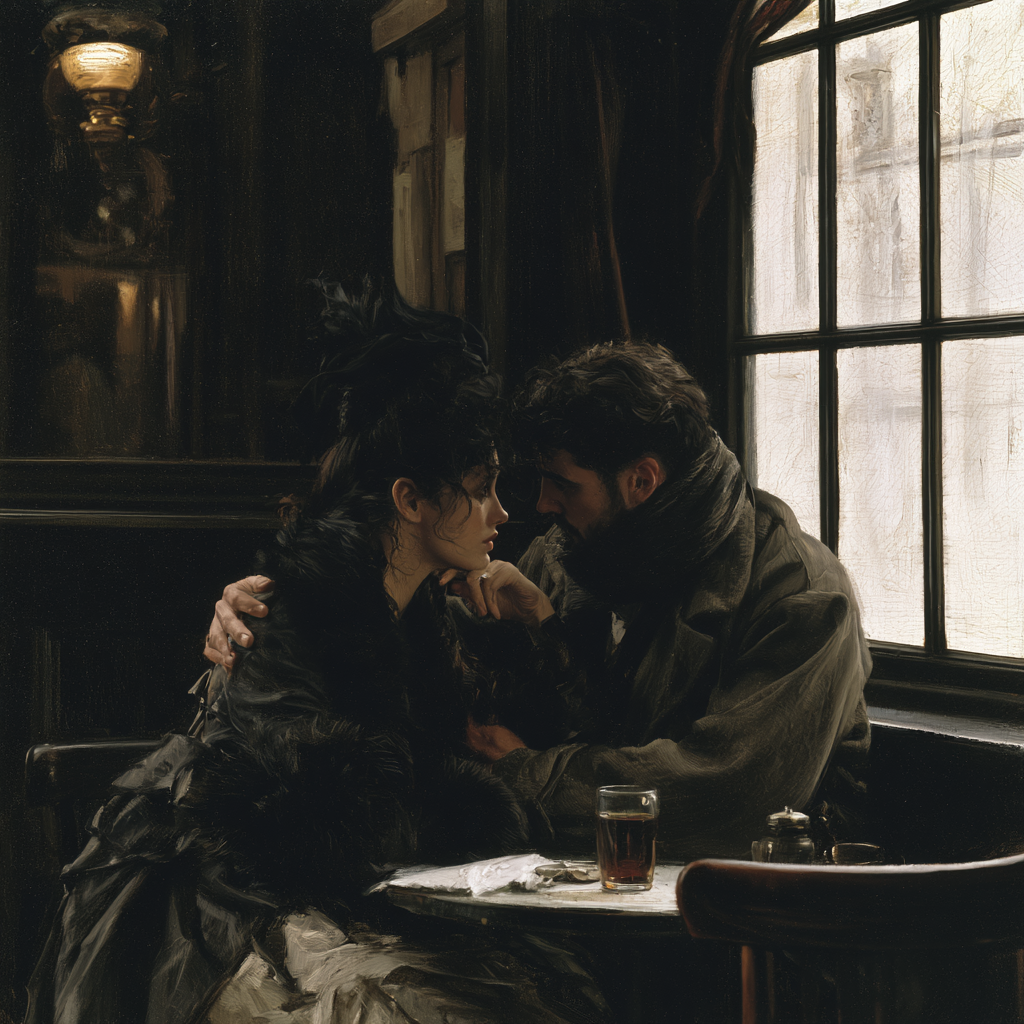
The gas lamp above them hissed with a low, constant sigh, a lonely yellow eye in the dark, paneled gloom of the café. Outside the fogged window, the cobbled street was a smear of wet slate and blurred, orange halos from distant carriage lamps. It was late. The serving girl had stopped wiping the tables an hour ago and had retreated to the back, leaving only the taciturn owner behind the bar, polishing a single glass with a rag that had long since ceased to be white.
They were the only patrons left.
She leaned into him, her body a dark, heavy curve of velvet and fur. The collar of her coat was thick, a ruff of black feathers and oiled fur that framed her face like a shadowed alcove. Her dark hair was swept up, a severe, elegant arrangement pinned with a single jet ornament, but a loose, heavy curl had escaped to fall across her pale cheek. Her eyes were wide, fixed on the window, staring at the wet, grey nothing outside.
He was pressed close, his shoulder against hers, his face turned toward her profile. He wore a heavy, rough wool coat, a thick scarf wrapped twice around his throat, obscuring his jaw. His hand rested on her shoulder, his fingers gripping the dark fur with a quiet, desperate pressure. His other hand was raised, his thumb brushing the cold, pale skin of her cheek, just below her eye. He was wiping away a tear he had seen catch the gaslight a moment before.
For a long time, neither of them spoke. The only sounds were the hiss of the lamp, the faint, distant drip of water from the eaves, and the slow, steady rhythm of their breathing.
"Tell me," he said, his voice low, gravelly, stripped of the polish of his public life. He was not a man who asked for much. He was a man who planned, who calculated, who moved the pieces of his life with a cold, meticulous precision. But in this dark, forgotten corner of the city, with her pressed against him, he was reduced to a single, naked plea.
She did not look at him. Her eyes stayed fixed on the window, on the blurred, distant shape of a passing figure.
"I am afraid," she whispered. Her voice was small, broken, a thin, brittle thread of sound that barely rose above the hiss of the lamp. "I am afraid that I have made a terrible mistake. And I am afraid that I am going to make another one."
He pressed his thumb deeper into her cheek, a soft, grounding pressure. "What mistake?"
She swallowed. He watched the sharp, elegant movement of her throat, the convulsive pulse that flickered beneath the pale, translucent skin.
"I told him I was going to the country," she said. "To visit my aunt. I told him I would be gone for three days." She let out a small, broken laugh, a sound that held no humor. "He did not even look up from his ledger. He simply nodded and asked me to bring him back a box of cigars from the village."
He felt the cold, sharp blade of her words lodge in his own chest. The man she had married—the wealthy, respectable, respectable man—did not even look up. She had fabricated a three-day absence, a gilded lie that could ruin her, and her husband's only response was a request for cigars.
He leaned closer. His forehead pressed against her temple, the rough wool of his coat brushing the soft, dark velvet of her shoulder. He closed his eyes. He breathed her in—the scent of damp fur, of her perfume, of the cold, wet air that clung to her skin.
"Then stay," he whispered. The words came out ragged, torn from the deepest, most reckless part of him. "Do not go back. Stay here. With me."
Her breath caught. A tiny, sharp intake of air that fogged the window in front of her. She turned her head, slowly, her dark eyes meeting his. The gaslight caught the tears pooled in her lower lashes, turning them into tiny, glittering shards.
"Stay here?" she repeated, her voice a fragile, trembling echo. "In this café? In this city? With no money, no plan, no future?"
"With me," he repeated. "That is the plan. That is the future."
She looked at him. She looked at the rough, frayed collar of his coat, the dark circles under his eyes, the desperate, naked hope that flickered in his gaze. He was not a wealthy man. He was a clerk, a man who worked for a living, who spent his days hunched over ledgers in a drafty office. He was not the kind of man she had been raised to marry.
But he was the only man who had ever looked at her and seen her. Not her dowry, not her family name, not the careful, immaculate surface of her social performance. He saw the woman who was terrified of the empty, respectable house she went home to every night. He saw the woman who had just told her husband a lie, and who was now sitting in a dark café, trembling against his shoulder, asking him to save her.
He raised his other hand. He cupped her face, his palms rough and warm against her cold, pale cheeks. He tilted her head, forcing her to hold his gaze.
"I have nothing," he said, his voice low, steady, a quiet anchor in the dark, gaslit room. "I have a small room in a boarding house. I have a salary that barely covers my rent and my meals. I have no connections, no prospects, no future that anyone would call promising."
He paused. His thumb traced the soft, wet curve of her lower lip.
"But I have this," he continued. "I have you. And I have the knowledge that I will spend the rest of my life trying to make you feel as safe as you do right now, in this moment, in this dark, forgotten café."
She did not speak. She simply looked at him, her dark eyes searching his face, reading the lines of exhaustion and desperation and fierce, unshakable love that had carved themselves into his features.
Slowly, she raised her hand. She pressed her palm against his chest, feeling the frantic, hummingbird beat of his heart beneath the rough wool of his coat.
"Pack your bags," she whispered. Her voice was no longer broken. It was quiet, steady, a still pool of water that had just found its bottom. "I will be at the train station. At dawn. I will be waiting."
He did not smile. He did not laugh. He simply let out a long, slow breath, a release of tension that seemed to drain the years of weary patience from his shoulders.
He leaned forward. He pressed his lips to her forehead, a slow, lingering kiss, sealing the pact, the escape, the fragile, desperate hope of a future they had not yet built.
She closed her eyes. She let the warmth of his mouth seep into her skin. She listened to the hiss of the gas lamp, the distant drip of the rain, the steady, solid rhythm of his heart beneath her palm.
The café was dark, cold, forgotten.
But for the first time in three years, she was not afraid.
They sat there, wrapped in the shadow of the gas lamp, their foreheads pressed together, their breath mingling in the cold, damp air. The serving girl did not come back. The owner did not look up from his glass. The world outside the fogged window continued its wet, grey, indifferent march.
But inside the café, two people had just decided to burn their old lives to the ground.
And in the quiet, gaslit dark, they held each other, waiting for the dawn to come.