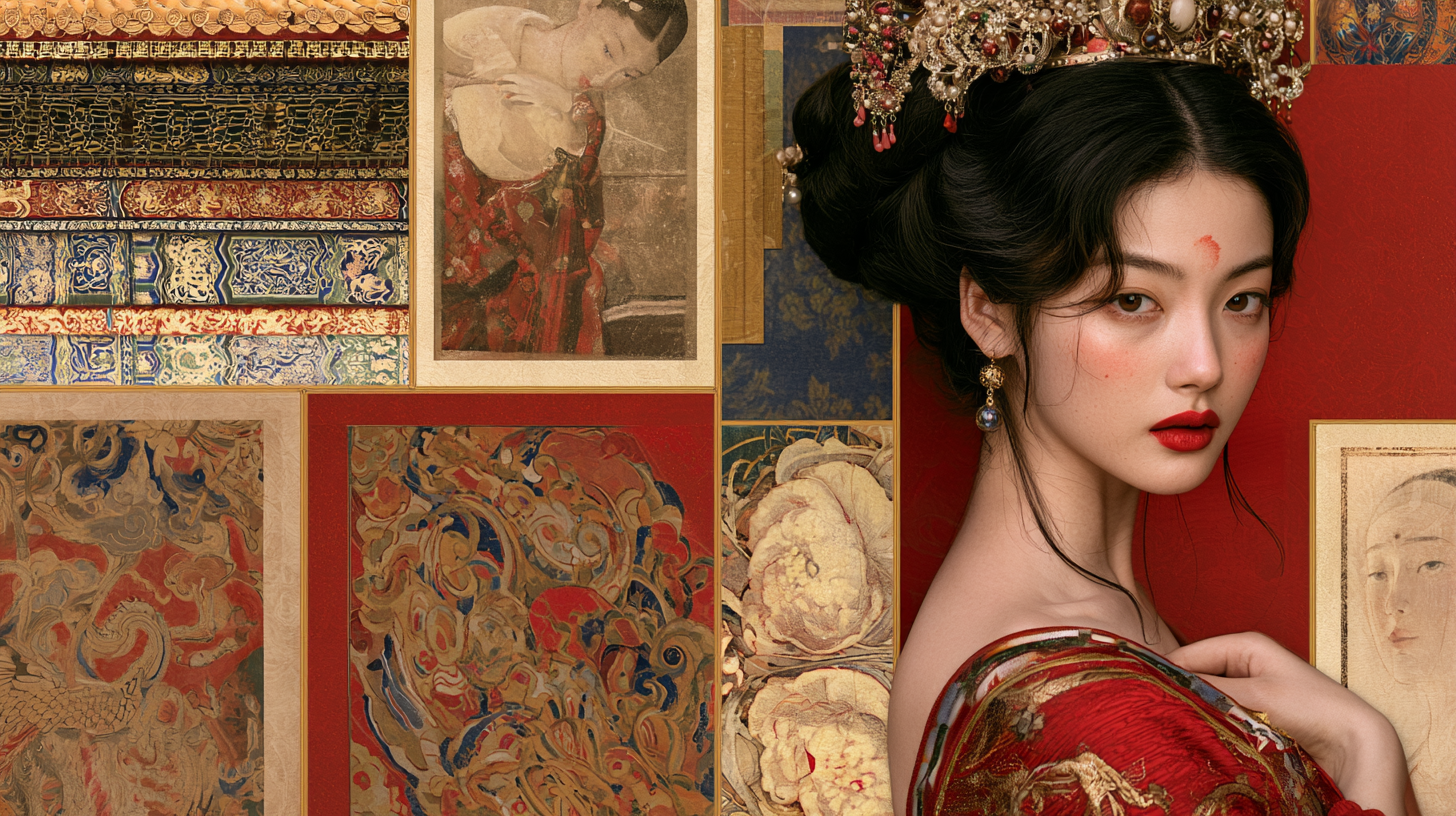
The silk had been hanging for four hundred years, preserved in the dry, monastic dark of the Hu family vault, but it had never been worn—not once. It had been a dowry for a bride who died before the contract was sealed, a ghost-gown passed down through generations of sons who were too afraid to touch it. It was only when Li Wei, at seventy-two, opened the lacquer chest in the back of his study that he understood why his ancestors had kept it sealed. The red was not a color; it was a temperature. It burned the eye.
He had spent the final decade of his life cataloguing the past, binding the fragments of his family’s faded glory into tidy volumes that no one would ever read. His son was in the south, trading salt; his daughter was married to a magistrate in the north. His wife—the only woman who had ever seen his unguarded face—had been dead for twenty-three years. He had convinced himself that his body was merely a vessel for memory, a bone-and-sinew archive, without appetite, without hope. He woke each morning to the sound of his own breathing, a hollow bellows in an empty house.
Then, from the chest, he unearthed the gown, and a smaller, newer note tucked beneath its hem. The note was from his granddaughter, Mei, written in a hurried, defiant script: I will wear this, if you will let me. I will wear it for the New Year festival. Not for the ghost. For you.
He had forgotten how to be surprised. He was, now.
She arrived at sunrise, and she did not wait for his permission. She walked into his study—the only room he had not allowed the maids to dust—and she placed the gown on the chaise as though she were laying a flag over a fallen soldier. He watched her from his desk, his quill frozen mid-stroke, as she began to prepare. She did not ask him to turn away. She did not apologize for the intimacy of the act.
The gown was designed for a woman who had never been touched. It revealed the geometry of the collarbone with the precision of a draughtsman’s line, leaving the entire slope of the shoulder bare, the faint indentations of the acromion visible like shallow basins carved into marble. The red silk—dyed with cochineal and mercury, glazed with an ancient lacquer—glowed against her pale skin as if the fabric were leaking light. She pinned her hair with the jade-and-pearl crown that had come with the dowry, a confounding monument of beads and gemstones that sat on her head like an empire’s ransom, heavy and hot. One stray strand of black hair escaped the pinning, falling across her cheek, and she did not tuck it away. She let it hang, an accidental breach of perfection that made her look less like a painted deity and more like a girl who had just run through the rain.
She turned to him. There was a tiny vermilion dot painted between her brows—a huadian—the only makeup she had allowed herself. It was the color of a fresh wound. Her lips were painted the same, so wide and deep they pulled the rest of the room into their orbit.
Li Wei had seen the corpse of his wife. He had held her hand long after the pulse had stopped. He had assumed that the human body, beyond a certain age, loses the ability to shock. He was wrong.
Mei stood in the centre of the room, surrounded by framed fragments of ancient tapestries, painted silks, paper-thin temple rubbings—all the dead art he had spent his life venerating. She was the only living thing among them. But she did not look fragile. She looked like a rebellion.
She wore no sleeve on her left arm, and the bareness of that limb—the gentle curve of the deltoid, the fine, downy hairs catching the early light, the faint blue vein that ran from elbow to wrist like a river on a map—was more intimate than any full exposure he had ever witnessed in the pleasure quarters of his youth. He had never seen his own daughter’s bare shoulder. He had never seen his wife’s, except in the darkness of the marital bed, when she had turned away from his gaze. Mei turned toward him. She held his gaze as a hostage holds a knife.
“You need to fasten the side clasp,” he said, his voice cracking like old leather. His throat was dry. He had not drunk water since the night before.
She lifted her chin, exposing the long tendon of her neck, the delicate ripple of cartilage that ran down into the hollow where her pulse beat visibly. He saw her throat move as she swallowed. She took three steps toward him, the heavy silk whispering against the floorboards, and stopped just short of his desk. The pearl on her earring caught the morning sun and threw a pinpoint of light onto the red lacquer wall behind her.
He could not stand. His legs felt like river stones.
“I am not wearing it for the family,” she said, her voice quiet but certain. “I am not wearing it for the ancestors. I am wearing it because I have watched you starve for ten years, and I refuse to watch it for an eleventh.”
Li Wei’s hands trembled on the desk. He thought of her as a child—a scrap of a girl who had been left in his care for two summers while her parents traveled. She had cried for her mother. He had sat beside her, rigid and silent, not knowing how to offer comfort. Now, that child had become a woman who understood the physics of seduction better than any courtesan: it was not in the revealing; it was in the remaining. She did not adjust the gown. She did not tug at the neckline. She stood utterly still, allowing the light, the silence, and his aging, longing eyes to do the work.
He felt his own body react, and it was not the reaction of a scholar. It was the reaction of a man buried alive who suddenly felt the roof of his coffin give way. The blood rushed to his face, to his hands, to the useless spaces of his chest he had assumed were hollow. It was not desire, not exactly—it was resurrection. It was the sudden, brutal memory that the world could still be entered, that the skin could still be a threshold.
He reached out, not to touch her, but to touch the edge of the gown where it fell from her shoulder. The silk was so fine it felt like spider-webbing against his calloused fingers. She did not flinch. She did not lean into him. She merely allowed his hand to hover an inch above the fabric, waiting.
And there, in that millimeter of air, between his aged hand and her bare shoulder, the entire history of his defeated life inverted. The ambition he had buried, the dream of being a painter—not a cataloguer, but a creator—rose up like a drowned man gasping for air. He looked into her eyes, and she returned the look without coyness, without modesty, without fear. She was not offering herself; she was offering him the duty of witnessing her.
She had chosen to be seen. That was her gift. That was her surrender—and it was the hardest thing he had ever received.
The bells of the distant temple struck the hour of the horse. The sun crawled higher, revealing the golden threads in the tapestry behind her, and for one brief moment, Li Wei saw the scene exactly as a painter would: the ancient red, the living flesh, the crown of jade, the single stray hair. He saw that he was not too old to paint. He was not too old to feel. He had merely forgotten that a body could be a form of prayer.
He finally exhaled. His hand fell to his lap.
“I will fasten the clasp,” he whispered, and she turned her back to him, presenting the narrow, pale expanse of her spine, the tiny pearls of vertebrae beneath the skin. Her patience was absolute. Her devotion was not to him as a man, but to him as a possibility.
He rose. His knees ached. But he rose, and he fastened the clasp, his fingers brushing the fabric of the gown—the gown that had waited four hundred years to be worn by a woman brave enough to stand still, while a man brave enough to begin again, reached out to hold her in place.