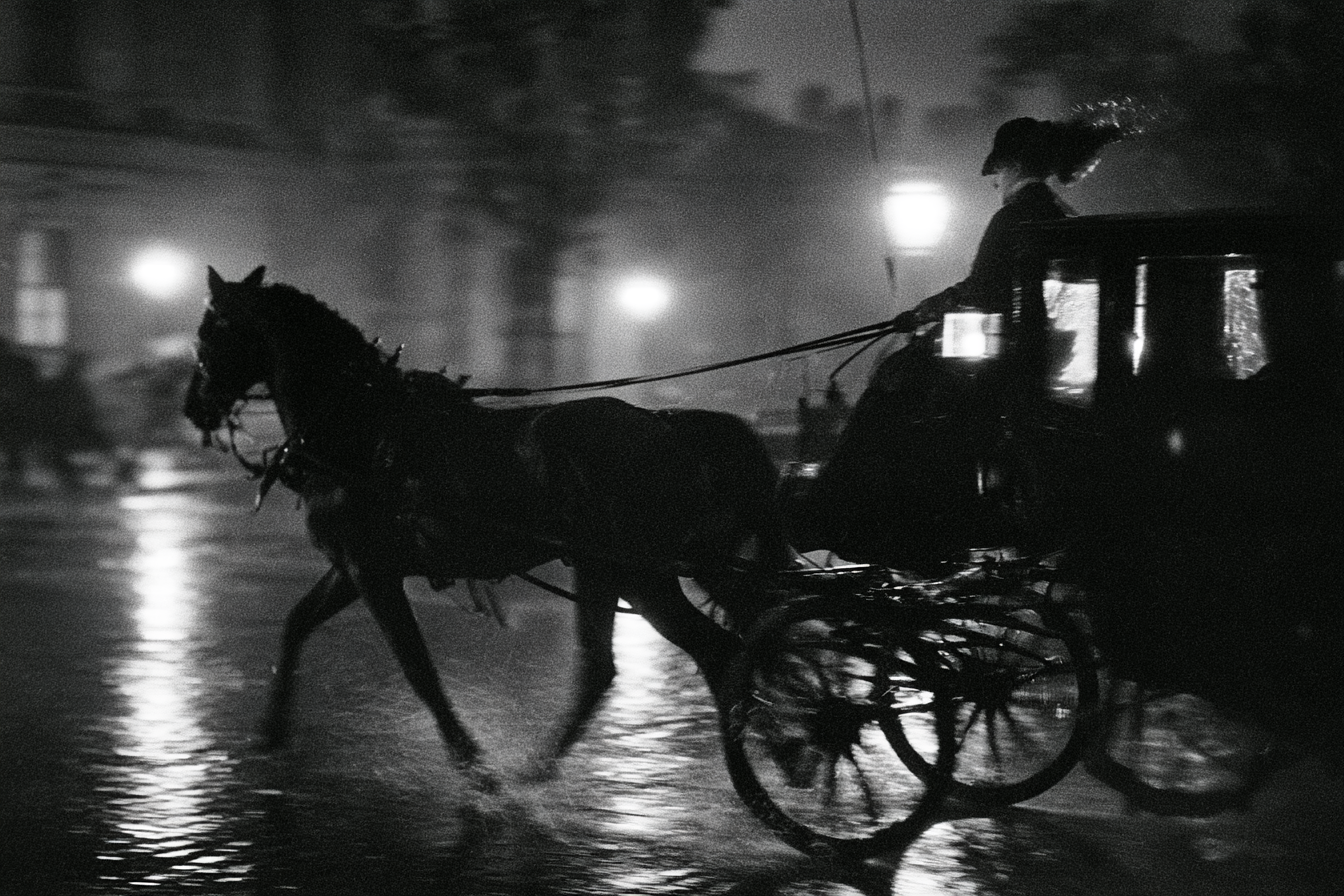
The second carriage passed me at dusk.
I had spent the intervening hours in a state of agitated suspension—walking the city’s wet, gaslit streets without seeing them, my mind a frantic loom weaving the same image over and over. The pale blue of her eyes. The stray curl. The way the amber light had fractured across her cheekbone. I was a man undone by a three-second glance, and I wore my unraveling like a hairshirt.
The first carriage had been an accident. The second was a calculation.
I had memorized the crest on the door—a dull silver gryphon rampant against a field of cobalt. It took three inquiries at the livery stables, a handful of coins, and a lie about a lost valise to learn the route. Her family kept a townhouse on the northern edge of the square, and twice a week, at the hour of the lighting of the lamps, she made the short journey to the dame’s school where she instructed the daughters of the merchant class in French and watercolors.
She taught French. She painted watercolors. And yet, the woman I had seen possessed a severity that could crack marble. The contradiction was exquisite.
I positioned myself at the corner of the square, just beyond the halo of the gaslamp, where the shadows were thick and the angle of the approaching carriage would allow me a full view of the window. I had prepared myself. I had rehearsed my posture—lean, casual, a man pausing to admire the brass fittings of his own watch chain. I had prepared my expression—pleasant, unreadable, the mild curiosity of a stranger.
When the carriage rounded the corner, my prepared composure detonated.
She was not looking out the window. She was reading. A small, leather-bound volume rested in her gloved hands, and her head was tilted downward, the heavy slope of the bonnet obscuring her brow. The light from the carriage’s interior lamp fell across her exposed face with a painterly precision—illuminating the fine, almost translucent skin of her eyelids, the faint blue veins at her temple, the satiny texture of her lips as they moved, silently, forming the words on the page.
She was utterly unaware of me.
That lack of awareness was devastating. She was not performing. She was not posing. She was simply living in her own interior world, and I had stumbled, a voyeur, into the sanctuary of her privacy. The erotic charge was not in being seen; it was in watching her not see me. It was the illicit thrill of beholding a woman in her natural state, unarmored by social performance.
I memorized the curve of her jaw as she turned a page. The delicate, almost imperceptible shift of her weight as she leaned into the rattling motion of the coach. The way the white lace at her throat rose and fell with the quiet, even rhythm of her breathing.
I wondered what she was reading. Was it a poem? A treatise? A scandalous novel hidden between the marbled covers of a harmless collection of sermons? My imagination, starved and hungry, supplied the answer. I imagined her reading a line of voluptuous, illicit verse, her pale cheeks flushing with a heat she could not control. I imagined her closing the book, pressing it to her chest, and letting out a trembling, silent sigh.
I wanted to be the sentence that made her sigh.
The carriage drew level with me. Ten feet. Eight. I stepped forward, out of the shadow, into the pool of jaundiced gaslight. It was a deliberate breach. I wanted her to see me. I wanted to force a repeat of the morning’s silent, electric communion.
She looked up.
Her eyes lifted from the page, slowly, as if drawn by a string, and landed directly on my face. The carriage continued to roll, but for a single, suspended heartbeat, time compresses. She recognized me. I saw the flicker—microscopic, almost imperceptible—a tiny dilation of her pupils in the low light.
Her expression did not change. It remained placid, sculptural, serene. But her hand, the one holding the book, did something entirely involuntary. Her thumb slid up the edge of the leather binding, and she pressed the pad of her thumb against her own lower lip—pressing, just slightly, against that soft, full swell. It was not a gesture of thought. It was a gesture of suppression. It was the physical effort to keep herself from speaking, from smiling, from acknowledging the invisible thread that had tethered us together across the darkening city.
She let the book drop to her lap. The carriage passed the gaslamp, and her face was thrown into momentary eclipse. Then, the lamp passed behind her, and she was illuminated again. And she did something that lodged itself in my sternum like a splinter.
She tilted her head—a bare inch—and let her gaze drop. She looked at my feet. Then my chest. Then my face. It was a slow, deliberate, appraising scan, carried out with the detached, clinical precision of a jeweler examining a stone for flaws. She was not admiring me; she was cataloguingme. And then, as the carriage began to pull away, she lifted her hand—her left hand, still gloved in fine, white kid—and touched the dark, navy silk of her bonnet. She traced the gold embroidery at her temple, a single, languid stroke of her fingertip against the fabric.
It was not a wave. It was not an invitation. It was the most obscure, private, and devastatingly intimate gesture I had ever witnessed. It was a woman touching the armor that covered her skull, as if to remind herself it was still there—and as if to show me, her silent, devoted shadow, that she knew I had been watching her try to remember.
The carriage vanished into the gloom of the upper square. I stood alone on the corner, the gaslight hissing above me, my heart hammering against the cage of my ribs.
I walked home in a daze. I did not eat dinner. I did not light the lamp in my study. I sat in the dark, my eyes fixed on the empty wallpaper, and I replayed that single, terrifying gesture—the pad of her thumb pressed to her lip, the appraising scan, the slow, deliberate touch of her fingertip against the gold embroidery of her bonnet.
She knew. She had always known. She had seen me on the pavement that morning, and she had taken my measure in the space of a breath. And tonight, she had given me a single, microscopic piece of evidence that I had passed her inspection.
I could not eat. I could not sleep. I could only sit in the dark and feel the slow, chemical burn of a desire that had moved, irrevocably, from the realm of abstract fantasy into the cold, terrifying reality of reciprocity.
The hunt had begun. And for the first time, I was not certain whether I was the hunter, or the prey.